
Blood sacrifices seemed messy. Life is messy. (Exodus 35-40, Leviticus 1, 4, 16, 19)

35:2
The sabbath was a pretty big deal back in the day. “Six days shall work be done, but on the seventh day there shall be to you an holy day, a sabbath of rest to the Lord: whosoever doeth work therein shall be put to death.” This sounds serious. Why was so much importance put on honoring the sabbath?
The Lord doesn’t need us to remember the sabbath. As Jesus said, “The sabbath was made for man, and not man for the sabbath.” The sabbath is a weekly event that recenters us. It’s a day for us to remember. It’s a day for us to recommit.
As we know, it’s very easy for us to slide - to slip. The sabbath acts as a bulwark to apostasy. Someone who is honoring the sabbath by attending church, partaking of the sacrament, using the day for rest and to grow closer to God will NOT apostatize. That person will not suddenly lose his or her testimony. It is a pretty big benefit to honoring the sabbath.
We know that we love those we serve. Marci loves our dog Elly much more than I do. A big reason why is that Marci cares about her, talks to her, cleans her, feeds her much much more than I do. Right now, I am in our office alone and Marci and Elly are somewhere else in the house. Rest assured that Elly is within ten feet of Marci. My point is that Marci serving Elly is what has cemented their bond. Marci truly, truly loves this dog. Her love is borne out of service.

I think honoring the sabbath can have a similar effect on our relationship with God. We ask for blessings all of the time from God. We see him as the giver. However, if we could flip that once a week where we are doing something to show our devotion to him, we would love him even more. If the great commandment is to love God - giving him our time once a week would be a great foundation for that.
As far as people being put to death for not honoring the sabbath, I’m reminded of a verse in chapter 19 of Exodus. “And thou shalt set bounds unto the people round about, saying, Take heed to yourselves, that ye go not up into the mount, or touch the border of it: whosoever toucheth the mount shall be surely put to death.” For those who simply touched the border of the mount, they would also be put to death.
Why the severe consequence of death? Was it really a big deal for someone to stand at the border of the mountain? Was it really a big deal for someone to break the sabbath? It warranted the death penalty? It seems severe and unreasonable.
But, once again, God knows human nature. God needed an obedient people. He needed to make a statement. The restriction and consequence both needed to be unequivocal. It couldn’t be soft and squishy. The Israelites needed to know that “this God ain’t playin.” This strictness would get out of hand eventually but, clearly, the Israelites needed the strict adherence to God’s law to keep them on the right path.
We could use a little more consequences these days. How many of us are strictly honoring the sabbath? For many of us, it just isn’t that big of a deal. As a result, we are missing out on an opportunity to build a long and lasting relationship with our Lord.
35:5
“Take ye from among you an offering unto the Lord: whosoever is of a willing heart, let him bring it, an offering of the Lord; gold, and silver, and brass…” This phrase should represent us and our reasons for doing good. If we are doing good because we feel compelled to by reward or punishment, that’s not a willing heart. If we are attending the temple weekly to check it off our list or perhaps to use it as a point of pride in some upcoming conversation with someone we want to impress - that’s not a very willing heart.
If, instead, we are doing righteous acts through a purely wiling heart (for the right reasons), our character will truly grow. We will develop into someone who does things for the right reasons without any ulterior motives.
35:10, 31-35
"And every wise hearted among you shall come, and make all that the Lord hath commanded.” This phrase “wise hearted” means “everyone that is talented or skilled.” The Lord has blessed us with talents and invites us to use them for the building up of the kingdom of God. The Lord needed craftsmen and weavers and goldsmiths and jewelers and linen spinners and engravers.

In our time, he may need teachers and movers and proselytizers and leaders and people who are good with children and church cleaners and ministers and temple goers and family history experts and ranchers and temple workers and missionaries and campers and farmers and organizers and service oriented people and kind hearted people etc etc.
As we covenant in the temple, we promise to give our time and talents and anything that we’ve been given or will be given to building the church. Our gifts are given to us. The Lord wants to to use our gifts for his purposes with a “willing heart.”
This is easier to do when we keep the perspective that God gave us gifts. “And he hath filled him with the spirit of God, in wisdom, in understanding, and in knowledge, and in all manner of workmanship; And to devise curious works, to work in gold, and in silver, and in brass, And in the cutting of stones, to set them, and in carving of wood, to make any manner of cunning work. And he hath put in his heart that he may teach, both he, and Aholiab, the son of Ahisamach, of the tribe of Dan. Them hath he filled with wisdom of heart, to work all manner of work, of the engraver, and of the cunning workman, and of the embroiderer, in blue, and in purple, in scarlet, and in fine linen, and of the weaver, even of them that do any work, and of those that devise cunning work.”
Whatever you can say “I have a talent for ________________,” remember that this talent of yours was given. As we keep this in mind, we will be more likely to use that gift for God’s purposes.
35:21
“And they came, every one whose heart stirred him up, and every one whom his spirit made willing, and they brought the Lord’s offering to the work of the tabernacle of the congregation, and for all his service, and for the holy garments.” Our hearts and our spirits are what motivates our mortal bodies. Our bodies want to sit on the couch. Our bodies don’t want to make ourselves vulnerable. It is our spiritual side who volunteers and desires righteousness. It is our open heart that responds to promptings.
When our open heart stirs us up to action, our spirit is what gets our bodies moving. If we allow our heart and spirit to drive us, we’ll do great things in building up this kingdom. We won’t need to be compelled. Whoever needs to be compelled to serve is a slothful servant. “The children of Israel brought a willing offering unto the Lord, every man and woman, whose heart made them willing to bring for all manner of work, which the Lord had commanded to be made by the hand of Moses.” When we choose righteousness on our own, we are submitting to God’s will and take one more step in becoming like him.
36:5-6
“And they spake unto Moses, saying, The people bring much more than enough for the service of the work, which the Lord commanded to make. And Moses gave commandment, and they caused it to be proclaimed throughout the camp, saying, Let neither man nor woman make any more work for the offering of the sanctuary. So the people were restrained from bringing. For the stuff they had was sufficient for all the work to make it, and too much.” This is wonderful. The people were asked to use their talents to produce what was needed for the tabernacle and they had more than they needed. Moses had to tell them to stop!

I would love to hear that from the podium at church. “Brother and Sisters, we need to scale back our ministering! There is way too much ministering happening in the ward!” I haven’t heard that in my 55 years. I don’t know when of if I will ever hear it. It’s too bad.
If we all were truly born again and became new creatures and submitted our will to the Lord, it’s plausible that our level of service might become bothersome to those who are being served. The widow might start wanting people to leave her yard after it was mowed and pruned and planted week after week. The victim of a tragedy may request that women stop showing up with meals.
That would be grand.
Leviticus
1:3
“If his offering be a burnt sacrifice of the herd, let him offer a male without blemish: he shall offer it of his own voluntary will at the door of the tabernacle of the congregation before the Lord.” The sacrifices made in the tabernacle and the tabernacle itself was meant to point the people towards their perfect Savior. Jesus Christ was the ultimate voluntary sacrifice. He was sinless.

There is no part of the gospel in the Old or New Testament that isn’t meant to direct us to Jesus. Unfortunately, the Israelites got caught up in the process and lost sight of the purpose. It should have been clear what their Messiah was meant to do. He was a sacrifice for sin - not a political liberator. The sacrifices that they made for hundreds of years was to help them understand the great and last sacrifice. They truly looked beyond the mark.
1:11-13
This process of offering blood sacrifices was messy. “And he shall kill it on the side of the altar northward before the Lord: and the priests, Aaron’s sons, shall sprinkle his blood round about upon the altar. And he shall cut it into his pieces, with his head and his fat: and the priest shall lay them in order on the wood that is on the fire which is upon the altar: But he shall wash the inwards and the legs with water: and the priest shall bring it all, and burn it upon the altar: it is a burnt sacrifice, an offering made by fire, of a sweet savour unto the Lord.”
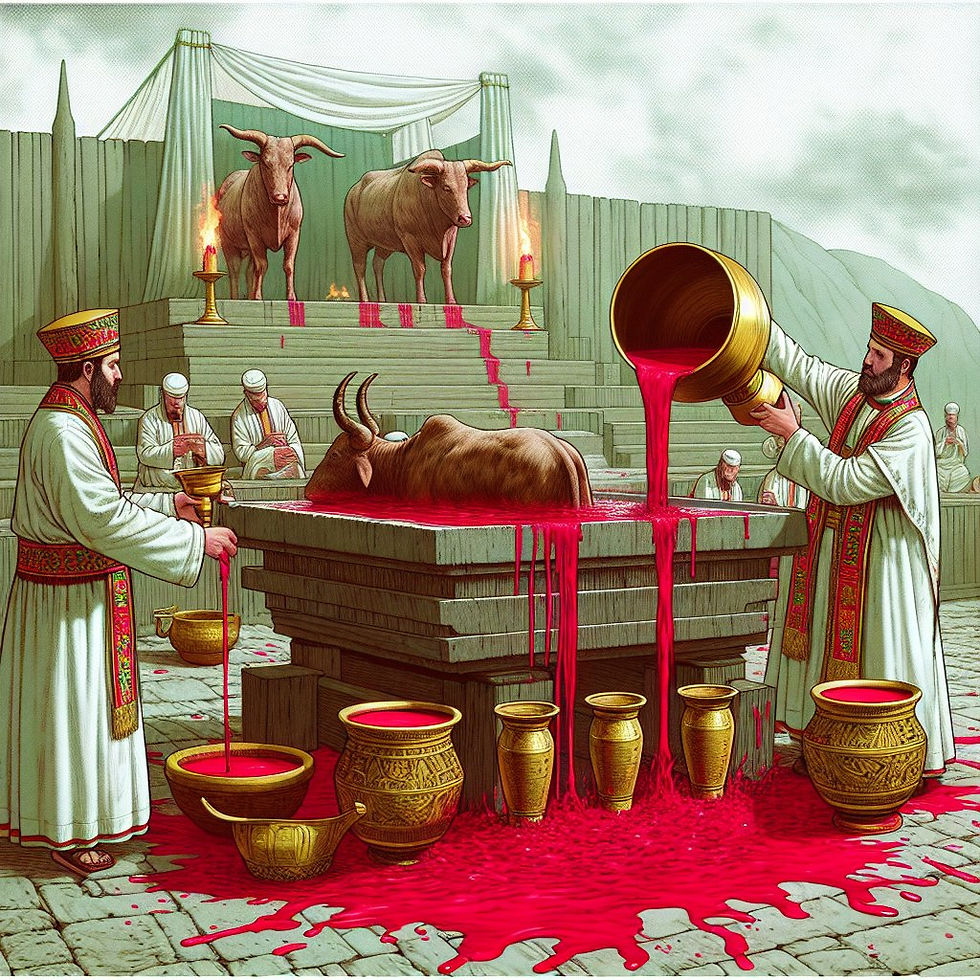
I can’t imagine this scene. It sounds gross and messy and traumatic! I think the point is that, while the plan of salvation is perfect and in order, mortal life is not. Our struggle through this life isn’t perfect and shiny. Our mortal experience is meant to be messy. Things don’t go according to plan. No one’s life can be considered a true “house of order.”
I think that expecting heaven on earth is not a reasonable expectation. Glory is coming but not in mortality. I’m sure it was confusing for the original apostles to be sleeping on the ground and going hungry and being chased by townspeople and soldiers and Pharisees. It was frustrating to see that their Messiah was struggling through a messy mortal experience just like everyone else. Jesus didn’t walk on marble walkways in manicured gardens. He walked on dusty roads and served the outcasts. He healed those who were considered unclean. He was among the blind, beggars and sinners. It wasn’t a beautiful scene made for TV.
When we go to church, we sometimes perceive other families to be perfect. They appear so. We MUST understand that EVERYONE has their own mess that they are dealing with. Everyone is struggling in some way. No one gets out of this life without something terrible to endure.
Having said all of that, I’m glad that our temples are clean and pristine and there isn’t blood covering the altars and the smell of burning meat in the celestial room.
16:8-10, 21-22
“And Aaron shall cast lots upon the two goats; one lot for the Lord, and the other lot for the scapegoat. And Aaron shall bring the goat upon which the Lord’s lot fell, and offer him for a sin offering. But the goat, on which the lot fell to be the scapegoat, shall be presented alive before the Lord, to make an atonement with him, and to let him go for a scapegoat into the wilderness.”

So, there were two goats offered on the Day of Atonement. Both of which were meant to represent Jesus Christ’s atonement. One was meant to be an offering and became a literal sacrifice. The second one was meant to be the “scapegoat.”
“And Aaron shall lay both his hands upon the head of the live goat, and confess over him all the iniquities of the children of Israel, and all their transgressions in all their sins, putting them upon the head of the goat, and shall send him away by the hand of a fit man into the wilderness: And the goat shall bear upon him all their iniquities unto a land not inhabited: and he shall let go the goat in the wilderness.” Obviously, being able to transfer the sins and iniquities of the people on the scapegoat represents the Savior taking on our sins.
Again, it was obvious that these ordinances were meant to point to Jesus Christ. It is a reminder for us to keep in the front of our mind that all of the ordinances that we participate in point to the Savior and are meant to draw closer to him. If we are not centered on Jesus as we do baptisms, confirmations, washing and anointing, endowments and sealings are all meant to point to Jesus Christ.
16:30
“For on that day shall the priest make an atonement for you, to cleanse you, that ye may be clean from all your sins before the Lord.” This is a good reminder that we are not atoning for ourselves. It is no act of our own that cleanses us. It is only through Christ’s atonement that we are cleansed. We need Him!
19:5
“And if ye offer a sacrifice of peace offerings unto the Lord, ye shall offer it at your own will.” Of course we should want to offer our sacrifice voluntarily. However, we are literally mean to sacrifice our will itself. This is our sacrifice - with a broken heart and contrite spirit. The purpose of a broken heart and contrite spirit is humility and submissiveness to our Creator’s will.
We can never be compelled to give up our will. That is a law of the universe. God will never destroy the agency of man. A war was fought in heaven over preserving our agency. For the rest of eternity, we will always have the ability to choose. It will always be our choice to follow Jesus. As we continue to give up our will for God’s will, we become more like him. We are more and more able to do what He does. We will become a new creature who will continue to work for others throughout eternity.
19:14-18
In these verses, we get some lessons about how to interact with each other:
“Thou shalt not curse the deaf, nor put a stumblingblock before the blind, but shalt fear thy God: I am the Lord.” I don’t know a lot of deaf or blind people - but I do know some stupid or inconsiderate or lazy or clueless or dishonest or people who drive slowly in the left lane. In other words, I know people who have weaknesses. I think this verse is encouraging me not to do or say something that makes it worse in any way for these weak people who often surround me when I in public…
“Ye shall do no unrighteousness in judgment: thou shalt not respect the person of the poor, nor honour the person of the mighty: but in righteousness shalt thou judge thy neighbour.” To me, this verse is telling me not to judge people based on their financial situation. I think we sometimes do that. Sometimes, we equate righteousness with wealth. Those who have a lot of money must be good people right? Those who are poor must have made some bad choices right? Nope. Some of the worst people are wealthy and some of the best people are the most Christlike people you’ll ever meet. We are capable of judging righteously and should only judge on principles of righteousness.
“Thou shalt not go up and down as a talebearer among thy people: neither shalt thou stand against the blood of thy neighbour: I am the Lord.” The footnote on “talebearer” says “gossip.” We are not supposed to gossip about our neighbors. We aren’t supposed to spread rumors. I have to admit that I love juicy gossip. I don’t know why but it’s definitely something that I need to work on.
“Thou shalt not hate thy brother in thine heart: thou shalt in any wise rebuke thy neighbour, and not suffer sin upon him. Thou shalt not avenge, nor bear any grudge against the children of thy people, but thou shalt love thy neighbour as thyself: I am the Lord.” We shouldn’t hate anyone. This is good advice during the times that we are living in. Holding grudges is horrible for our spirits. There is so much hating and grudge-holding going on in the world today. Instead, we should be loving our neighbor - and our enemy.
19:31
“Regard not them that have familiar spirits, neither seek after wizards, to be defiled by them: I am the Lord your God.” We are seeing this happen more and more frequently. I wrote about this during this very week four years ago. At the time, we had just visited with some friends who were seeing a psychic. We warned them that it would lead somewhere that wasn’t good. We were proven right, those friends are no longer part of the church. Their reliance on psychics lead to a belief in crystals and astrology. She has become a shaman. They believe in the power of the earth and the elements and the universe guiding us.

At the time, we encouraged them to not complicate their beliefs and not introduce other sources of truth besides the Spirit and the prophet and the scriptures. There isn’t some grand, un-understandable force that is behind everything. There is nothing mystical about the plan of salvation. It is simply that we have a Father in Heaven who has progressed beyond anything that we can comprehend - who loves us and wants us to progress to be like him. He has given us his Spirit to guide us when we have questions or comfort us when we face trials. He gave his son to teach us and provide a perfect example for us and to pay for our sins so we don’t have to if we accept the atonement. Because of his Son, we will receive a perfect body just like the one that he has. The purpose of this life is to be proven and to learn right from wrong for ourselves. He provided prophets who wrote things down into scripture to be a literal black and white guidebook about what we should be doing. It’s pretty simple.
It has nothing to do with crystals or stars’ alignment or fire or water or psychic abilities. The minute they turned from the Spirit as their primary guide, they were on a path away from the gospel. Of course, we were right - unfortunately.
I’m grateful for the straightforwardness of the gospel and the plan of salvation. I’m glad I don’t have to search for truth through those who think they have some gift given from the universe. Our focus must be on the Savior. We must rely on the Spirit and the scriptures and the prophet and our personal prayers - not peeing wizards. :)


Comments