
How easy is it to justify disobedience? (1 Samuel 8-10, 13, 15-18)
- Marci & Eric

- Jun 13, 2022
- 13 min read
8:5
Humans generally like following trends. If we know something is popular, we desire it too. It’s some form of ‘keeping up with the Joneses.’ I don’t know why we are like this - I think it has to do with pride. It’s not about what we have, it’s that we have more than those other people.
Also, there were natural consequences to Samuel’s sons‘ behavior. “And his sons walked not in his ways, but turned aside after lucre, and took bribes, and perverted judgment.”
As a consequence, the people responded. “And said unto him, Behold, thou art old, and thy sons walk not in thy ways: now make us a king to judge us like all the nations.”
I think this is also a case of ‘the grass is greener.’ We don’t like what we have so we assume that something else is better. Sometimes, it’s worse.
9:2, 21
Saul was blessed physically. “And he had a son, whose name was Saul, a choice young man, and a goodly: and there was not among the children of Israel a goodlier person than he: from his shoulders and upward he was higher than any of the people.” In this case, ‘goodly’ means talented.

Interestingly, with all of the ways Saul is blessed, he still doesn’t feel worthy. When Samuel suggested that the ”desire of Israel” was on him, Saul expressed self-doubt. “And Saul answered and said, Am not I a Benjamite, of the smallest of the tribes of Israel? and my family the least of all the families of the tribe of Benjamin? wherefore then speakest thou so to me?” It’s a good example of how, no matter how strong our talents are, we still doubt ourselves.
Many of us have had self-doubt when given a calling. It’s natural. Even the hyper-talented and strong Saul felt this way.
10:2-7
A couple of things with these verses. First, when we are doing God’s will, he makes way for us. He helps us along the path - even temporally. In the case of Saul, there were a few examples:
“When thou art departed from me to day, then thou shalt find two men by Rachel’s sepulchre in the border of Benjamin at Zelzah; and they will say unto thee, The asses which thou wentest to seek are found.” The whole purpose of Saul’s original journey was to find the asses. God was able to resolve that issue.
“Then shalt thou go on forward from thence, and thou shalt come to the plain of Tabor, and there shall meet thee three men going up to God to Beth-el, one carrying three kids, and another carrying three loaves of bread, and another carrying a bottle of wine: And they will salute thee, and give thee two loaves of bread; which thou shalt receive of their hands.” The Lord ensured that Saul as fed along his journey.
”After that thou shalt come to the hill of God, where is the garrison of the Philistines: and it shall come to pass, when thou art come thither to the city, that thou shalt meet a company of prophets coming down from the high place with a psaltery, and a tabret, and a pipe, and a harp, before them; and they shall prophesy.” This is part of Saul’s transformation into a king. He would meet those who could prophesy. This would lead to Saul himself prophesying.
“And the Spirit of the Lord will come upon thee, and thou shalt prophesy with them, and shalt be turned into another man.” We are all wanting to be turned into ”another man.” We are all natural men to some degree. Through the Spirit, we can be changed into something different. When our hearts are finally and fully changed by the Spirit, we completely lose the desire and ability to sin. We stop rebelling to any degree. We submit our will fully. When this happens, we are a different person.
As a reminder, it isn’t through our own self-mastery that this happens. It is a gift given from God. If we are changed, it’s not something to feel proud of. It is a humbling experience realizing that we are simply relying on the mercies of God and his Son. This is further illustrated in verse 9. “And it was so, that when he had turned his back to go from Samuel, God gave him another heart: and all those signs came to pass that day.” This level of progression is a gift given to us.
When this happens, we should accept the responsibility of being a sharpened tool in God’s hands. We constantly look for opportunities to bless others. “And let it be, when these signs are come unto thee, that thou do as occasion serve thee; for God is with thee.” Having God with us is a blessing AND a responsibility!
13:11-14
Saul was leading a group of people who were threatened by the Philistines. Saul was supposed to wait for Samuel to bless them and offer burnt offerings. I’m sure Saul felt pressure to do this sooner than later. He didn’t wait for Samuel.

”And Samuel said, What hast thou done? And Saul said, Because I saw that the people were scattered from me, and that thou camest not within the days appointed, and that the Philistines gathered themselves together at Michmash; Therefore said I, The Philistines will come down now upon me to Gilgal, and I have not made supplication unto the Lord: I forced myself therefore, and offered a burnt offering.”
This wasn’t good. “And Samuel said to Saul, Thou hast done foolishly: thou hast not kept the commandment of the Lord thy God, which he commanded thee: for now would the Lord have established thy kingdom upon Israel for ever.” Because Saul had not followed directions from the Lord, there were going to be consequences.
Samuel continued, “But now thy kingdom shall not continue: the Lord hath sought him a man after his own heart, and the Lord hath commanded him to be captain over his people, because thou hast not kept that which the Lord commanded thee.”
At first, this seemed harsh to me. Saul just wanted to move things along. He was feeling pressure and didn’t want to wait. He felt, as leader, he could offer the burnt offerings himself instead of waiting for Samuel - a seemingly reasonable thought.
However, it does indicate pride and a rebellious attitude. He wasn’t submitting to direction from his spiritual leader. This attitude would likely take him off track. Samuel was very worried about what a wicked king could do to Israel. Seeing Saul disregard this simple direction was a red flag. It suggests future, increasing rebellion against God’s will. Pride and power is not a good combination.
15:1, 3, 9, 11, 13, 15
Samuel commands that Saul be obedient. “Samuel also said unto Saul, The Lord sent me to anoint thee to be king over his people, over Israel: now therefore hearken thou unto the voice of the words of the Lord.” He is asking Saul to submit to the word of the Lord.
”Now go and smite Amalek, and utterly destroy all that they have, and spare them not; but slay both man and woman, infant and suckling, ox and sheep, camel and ass.” Samuel is telling Saul to kill everything.

But, again, Saul decides that he knows better. “But Saul and the people spared Agag, and the best of the sheep, and of the oxen, and of the fatlings, and the lambs, and all that was good, and would not utterly destroy them: but every thing that was vile and refuse, that they destroyed utterly.”
He justified a different course. It didn’t make sense to kill the good animals. He did what made sense to him rather than what the Lord had told him. Do we do this? Yes we do. We rationalize our behavior based on our assessment of the situation.
We skip church because family time is important.
We watch a movie that we shouldn’t because there are some important historical stories included.
We don’t keep the sabbath because we’re providing for our family.
This list could get long of times that we decide that we know what’s best - even if it contradicts what we’ve been commanded or urged or asked to do.
Samuel recognizes this red flag. “It repenteth me that I have set up Saul to be king: for he is turned back from following me, and hath not performed my commandments. And it grieved Samuel; and he cried unto the Lord all night.” He sees that Saul places his own wisdom over God’s. That’s a bad quality in a king.
But from Saul’s perspective, he had done the right thing and followed God’s will. “…and Saul said unto him, Blessed be thou of the Lord: I have performed the commandment of the Lord.” From his perspective, he was being obedient. This is the worst kind of sin - the kind where we don’t even think it’s a sin! How can we ever repent of something if we don’t think we have anything to repent for?!
Saul further justified keeping the good animals. “And Saul said, They have brought them from the Amalekites: for the people spared the best of the sheep and of the oxen, to sacrifice unto the Lord thy God; and the rest we have utterly destroyed.” In Saul’s mind, he had broken the commandment for a good and righteous purpose. He rationalized that, since it was for a sacrifice to God, keeping the animals was right.
Again, the problem is putting our own wisdom above God’s. Our little brains can’t see around corners like God’s mind can. Also, God’s ways are not our ways. His thinking is on a higher plane than ours. So, it’s not for us to decide whether something God has commanded us is a good idea. We have only to obey.
I think this is going to be a bigger and bigger problem in our church. The church’s stance on issues isn’t going to ‘make sense’ to a lot of members and they are going to follow their own wisdom rather than God’s. Watch and see.
15:22-23
Samuel explains the issue with Saul’s rationalized sacrifice. “And Samuel said, Hath the Lord as great delight in burnt offerings and sacrifices, as in obeying the voice of the Lord? Behold, to obey is better than sacrifice, and to hearken than the fat of rams.“ God wants our obedience more than physical sacrifice.

God isn’t attempting to create a bunch of ‘sacrificers.‘ His work is to help us progress to be just like him. For that, he needs us to be teachable and obedient. So, obedience is a foundation of our progress. The Lord delights in our obedience.
He further explains. “For rebellion is as the sin of witchcraft, and stubbornness is as iniquity and idolatry.” Rebellion and stubbornness damn us as much as sin and iniquity. Read that again. Many church members don’t struggle with sin as much as they do stubbornness. Consider your mini-rebellions or stubbornness.
15:24-26
Fortunately, Saul accepts his mistake. He sees why he chose what he did. “And Saul said unto Samuel, I have sinned: for I have transgressed the commandment of the Lord, and thy words: because I feared the people, and obeyed their voice.” He realized that he thought more about the opinion of the people than God’s commandment. We should consider how much value we place on others’ opinion in comparison with our willingness to follow God’s word.
This is going to be a bigger and bigger problem for church members in this changing world!
16:6, 12
Samuel was on the lookout for the next king. “And it came to pass, when they were come, that he looked on Eliab, and said, Surely the Lord’s anointed is before him.“
To Samuel’s eyes, Eliab was the right choice. He must have looked good. He must have looked strong. But the Lord corrected/instructed him. “But the Lord said unto Samuel, Look not on his countenance, or on the height of his stature; because I have refused him: for the Lord seeth not as man seeth; for man looketh on the outward appearance, but the Lord looketh on the heart.”
I am guilty of judging people by their appearance and mannerisms. I feel like I’m a good judge of character and can understand someone quickly through observation. I, like most people, are drawn towards good looking people. If someone looks wise and refined and professional, I give them more credibility before they even say one word. It’s not good.
Some of the people who have had the most influence on me have not been easy on the eyes. The Lord definitely doesn’t judge someone by the appearance and neither should we.
16:14
”But the Spirit of the Lord departed from Saul, and an evil spirit from the Lord troubled him.” When we don’t have the Spirit of the Lord in us, it is replaced with someone else. Something always fills that vacuum.
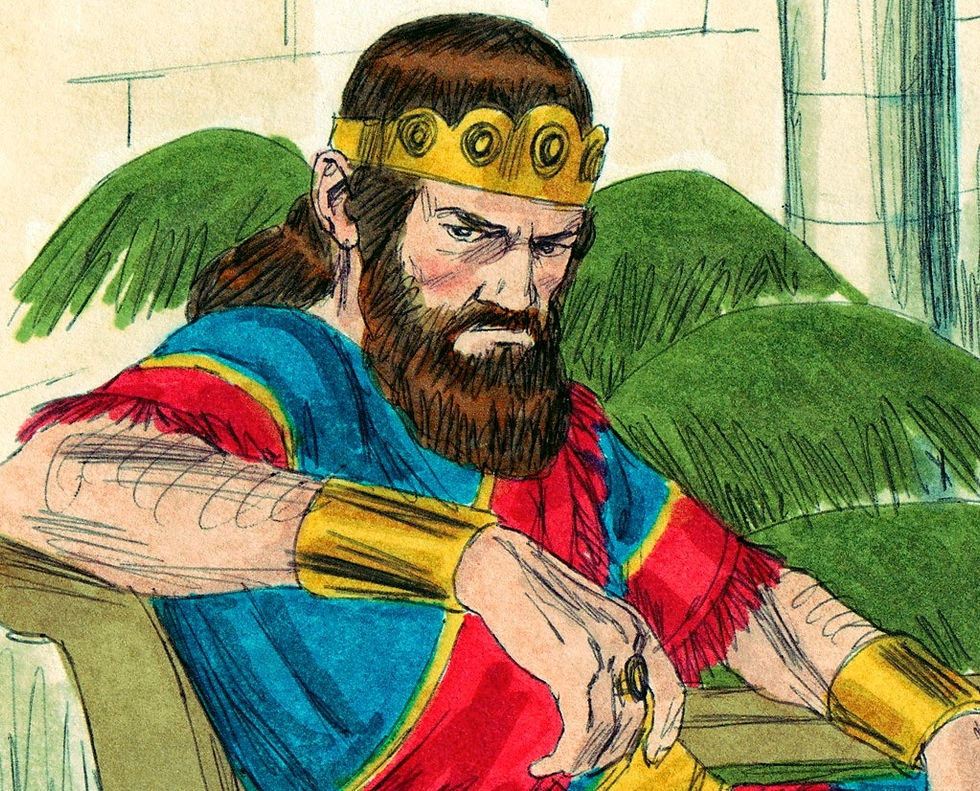
It’s similar to the principle of ‘you’re either going forward or backward - there is no stopping.’ We need to hearken to the promptings of the Spirit so he remains with us.
17:33
Saul discounted David because of his age. “And Saul said to David, Thou art not able to go against this Philistine to fight with him: for thou art but a youth, and he a man of war from his youth.” It made no logical sense that David would be able to compete with Goliath.
Our skills and talents are secondary to whether God is with us. We must remember that when we are embarking on a duty, mission, visit, calling that feel overwhelming. It is overwhelming for us on our own but with God, “nothing shall be impossible.“
17:34-37, 45-47
David had a reason to be confident. “And David said unto Saul, Thy servant kept his father’s sheep, and there came a lion, and a bear, and took a lamb out of the flock: And I went out after him, and smote him, and delivered it out of his mouth: and when he arose against me, I caught him by his beard, and smote him, and slew him.” This is impressive! However, unlike Samson, this impressive feat doesn’t give David confidence in himself - rather, it gives him confidence in the Lord. He gives credit to God rather than on his own skill.
David continued, “Thy servant slew both the lion and the bear: and this uncircumcised Philistine shall be as one of them, seeing he hath defied the armies of the living God. David said moreover, The Lord that delivered me out of the paw of the lion, and out of the paw of the bear, he will deliver me out of the hand of this Philistine. And Saul said unto David, Go, and the Lord be with thee.” Because David had faith in the Lord - not himself, he was powerful.

His past successes hadn’t built pride in him. Instead, it built faith in the Lord. He knew that the Philistines had “defied the armies of the living God” and would certainly be conquered. He saw his place in God’s plan.
He had so much faith, he was willing to put his life on the line. If he was wrong, he would die. That’s a lot of faith.
David was clear about his place. “Then said David to the Philistine, Thou comest to me with a sword, and with a spear, and with a shield: but I come to thee in the name of the Lord of hosts, the God of the armies of Israel, whom thou hast defied. This day will the Lord deliver thee into mine hand.” He knew that it wasn’t about the weapons or the physical strength. Those things are meaningless when God is with you.
David summarizes this point, “And all this assembly shall know that the Lord saveth not with sword and spear: for the battle is the Lord’s, and he will give you into our hands.” If we engaged in the work of the Lord, earthly weapons cannot stop us.
18:6-9
Saul enjoyed popularity after this event. “And it came to pass as they came, when David was returned from the slaughter of the Philistine, that the women came out of all cities of Israel, singing and dancing, to meet king Saul, with tabrets, with joy, and with instruments of musick. And the women answered one another as they played, and said, Saul hath slain his thousands, and David his ten thousands.” Of course, the Israelites weren’t giving the credit to the Lord. They were giving it to David. This isn’t good.

Saul didn’t like it. “And Saul was very wroth, and the saying displeased him; and he said, They have ascribed unto David ten thousands, and to me they have ascribed but thousands: and what can he have more but the kingdom? And Saul eyed David from that day and forward.” We humans are naturally jealous. It isn’t about what we have - only that we have more than the other guy. Saul would have loved women singing about the thousands he’s conquered. It wasn’t until they cheered David and his “ten thousands” that it hurt his feelings.
18:14-15
”And David behaved himself wisely in all his ways; and the Lord was with him. Wherefore when Saul saw that he behaved himself very wisely, he was afraid of him.” I wish I knew all of the ways that David “behaved himself wisely.” It would likely be a roadmap to success…
It’s interesting that Saul was afraid of him. I think when we know we’re doing wrong, we’re intimidated by those we know are choosing the right. Our spirits recognize the difference and it hurts our self-esteem.
18:18, 23
The key to David’s early success is his humility. Even though he was accomplished, revered - even worshipped - he never lost his humility. When Saul offered him a daughter, David questioned him. “And David said unto Saul, Who am I? and what is my life, or my father’s family in Israel, that I should be son in law to the king?” He didn’t see himself as special. This helps him be obedient and progress.
Saul attempted to flatter David through his servants. “And Saul commanded his servants, saying, Commune with David secretly, and say, Behold, the king hath delight in thee, and all his servants love thee: now therefore be the king’s son in law.” Most of us respond very well to flattery. It’s a good strategy.
David again responded with humility. “And David said, Seemeth it to you a light thing to be a king’s son in law, seeing that I am a poor man, and lightly esteemed?” He didn’t think he should be given a wife.
However, when Saul offered a challenge of bringing a hundred foreskins to earn his wife - David liked that idea. In fact, He slew two hundred men. I’m not sure what this means in terms of David’s character… It does make sense that he didn’t want to be simply given something - he wanted to earn it.
18:29
This is an interesting verse. “And Saul was yet the more afraid of David; and Saul became David’s enemy continually.” I’m not sure what that last part means. Does it mean that Saul continually did things that hurt David?
I personally believe that Saul was continually getting worked up in his mind. He was likely fixated on David and rethinking his concerns/fears/insecurities. He likely looked for things to be offended by. He probably read into David’s actions some ulterior motive.
I think we do this sometimes. When we have a problem with someone, rather than simply forgive and move on, we fixate. We ponder the different ways that this person has hurt us. We get angrier and angrier. It’s not good and not the way we want to live. It ultimately makes us miserable and the other person might not even be aware of us. Let’s not do that.


Comments